CYBERMED LIFE - ORGANIC  & NATURAL LIVING
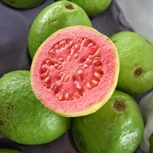
Guava

Guava: Guavas (singular guava /ˈɡwɑːvə/) are common tropical fruits cultivated and enjoyed in many tropical and subtropical regions. Psidium guajava (common guava, lemon guava) is a small tree in the Myrtle family (Myrtaceae), native to Mexico, Central America, and northern South America. Although related species may also be called guavas, they belong to other species or genera, such as the "pineapple guava" Acca sellowiana. In 2011, India was the largest producer of guavas.

Types

The most frequently eaten species, and the one often simply referred to as "the guava", is the apple guava (Psidium guajava). Guavas are typical Myrtoideae, with tough dark leaves that are opposite, simple, elliptic to ovate and 5–15 centimetres (2.0–5.9 in) long. The flowers are white, with five petals and numerous stamens. The fruits are many-seeded berries.

The genera Accara and Acca (formerly Feijoa, pineapple guava) were formerly included in Psidium.

Etymology and regional names

The term "guava" appears to derive from Arawak guayabo "guava tree", via the Spanish guayaba. It has been adapted in many European and Asian languages, having a similar form.

Another term for guavas is peru, derived from pear. It is common in countries bordering the western Indian Ocean and probably derives from Spanish or Portuguese. In parts of the Indian subcontinent and Middle-East, guava is called amrood, possibly a variant of armoot meaning "pear" in the Arabic and Turkish languages. It is known as the payara in Bangladesh. It is known as bayabas in the Philippines.

Origin and distribution

Guavas originated from an area thought to extend from Mexico or Central America and were distributed throughout tropical America and Caribbean region. They were adopted as a crop in subtropical and tropical Asia, the southern United States (from Tennessee and North Carolina south, as well as the west and Hawaii), tropical Africa, South Asia, Southeast Asia, and Oceania. Guavas are now cultivated in many tropical and subtropical countries. Several species are grown commercially; apple guava and its cultivars are those most commonly traded internationally. Guavas also grow in southwestern Europe, specifically the Costa del Sol on Málaga, (Spain) and Greece where guavas have been commercially grown since the middle of the 20th century and they proliferate as cultivars.

Mature trees of most species are fairly cold-hardy and can survive temperatures slightly colder than 25 °F (−4 °C) for short periods of time, but younger plants will likely freeze to the ground.

Guavas were introduced to Florida in the 19th century and are now grown in Florida as far north as Sarasota, Chipley, Waldo and Fort Pierce. However, they are a primary host of the Caribbean fruit fly and must be protected against infestation in areas of Florida where this pest is present.

Guavas are of interest to home growers in subtropical areas as one of the few tropical fruits that can grow to fruiting size in pots indoors. When grown from seed, guavas bear fruit as soon as two years and as long as 40 years.

Ecology

Psidium species are used as food plants by the caterpillars of some Lepidoptera, mainly moths like the Ello Sphinx (Erinnyis ello), Eupseudosoma aberrans, E. involutum, and Hypercompe icasia. Mites, like Pronematus pruni and Tydeus munsteri, are known to be crop pests of the apple guava (P. guajava) and perhaps other species. The bacterium Erwinia psidii causes rot diseases of the apple guava.

Although the fruit is cultivated and favored by humans, many animals and birds consume it, readily dispersing the seeds in their droppings and, in Hawaii, strawberry guava (P. littorale) has become an aggressive invasive species threatening extinction to more than 100 other plant species. By contrast, several guava species have become rare due to habitat destruction and at least one (Jamaican guava, P. dumetorum), is already extinct.

Guava wood is used for meat smoking in Hawaii and is used at barbecue competitions across the United States. In Cuba and Mexico, the leaves are used in barbecues.

Fruit

Guava fruits, usually 4 to 12 centimetres (1.6 to 4.7 in) long, are round or oval depending on the species. They have a pronounced and typical fragrance, similar to lemon rind but less sharp. The outer skin may be rough, often with a bitter taste, or soft and sweet. Varying between species, the skin can be any thickness, is usually green before maturity, but becomes yellow, maroon, or green when ripe. The pulp inside may be sweet or sour and off-white ("white" guavas) to deep pink ("red" guavas). The seeds in the central pulp vary in number and hardness, depending on species.

Culinary uses

In Mexico, the guava agua fresca beverage is popular. The entire fruit is a key ingredient in punch, and the juice is often used in culinary sauces (hot or cold), as well as artisan candies, dried snacks, fruit bars, desserts, or dipped in chamoy. Pulque de guava is a popular blend of the native alcoholic beverage.

In many countries, guava is eaten raw, typically cut into quarters or eaten like an apple, whereas in other countries it is eaten with a pinch of salt and pepper, cayenne powder or a mix of spices (masala). It is known as the winter national fruit of Pakistan. In the Philippines, ripe guava is used in cooking sinigang. Guava is a popular snack in Taiwan, sold on many street corners and night markets during hot weather, accompanied by packets of dried plum powder mixed with sugar and salt for dipping. In east Asia, guava is commonly eaten with sweet and sour dried plum powder mixtures. Guava juice is popular in many countries. The fruit is also often prepared in fruit salads.

Because of its high level of pectin, guavas are extensively used to make candies, preserves, jellies, jams, and marmalades (such as Brazilian goiabada and Colombian and Venezuelan bocadillo), and also for juices and aguas frescas or may be used in a marmalade jam on toast.

Red guavas can be used as the base of salted products such as sauces, substituting for tomatoes, especially to minimize acidity. A drink may be made from an infusion of guava fruits and leaves, which in Brazil is called chá-de-goiabeira, i.e., "tea" of guava tree leaves, considered medicinal.


  • Vitamin C effective in targeting cancer stem cells

    facebook Share on Facebook

    Researchers measure the impact on cancer stem cell metabolism of 3 natural substances, 3 experimental pharmaceuticals and 1 clinical drug.

    Vitamin C is up to ten times more effective at stopping cancer cell growth than pharmaceuticals such as 2-DG, according to scientists in Salford, UK.

    The research, published in Oncotarget, is the first evidence that Vitamin C (ascorbic acid) can be used to target and kill cancer stem cells (CSCs), the cells responsible for fuelling fatal tumours.

    Dr Michael P. Lisanti, Professor of Translational Medicine at the University of Salford, said: "We have been looking at how to target cancer stem cells with a range of natural substances including silibinin (milk thistle) and CAPE, a honey-bee derivative, but by far the most exciting are the results with Vitamin C.

    "Vitamin C is cheap, natural, non-toxic and readily available so to have it as a potential weapon in the fight against cancer would be a significant step."

    Cancer stem-like cells are thought to be the root cause of chemotherapy resistance, leading to treatment failure in patients with advanced disease and the triggers of tumour recurrence and metastasis (regrowth).

    The Salford team set out to assess the bioenergetics of cancer stem cells -- the processes which allow the cells to live and thrive -- with a view to disrupting their metabolism.

    Focusing on energy-transfer, they measured the impact on cell lines in a laboratory of 7 substances, the clinically-approved drug stiripentol, 3 natural products -- caffeic acid phenyl ester (CAPE), silibinin and ascorbic acid -- and experimental pharmaceuticals, such as actinonin, FK866 and 2-DG.

    While they found that natural antibiotic actinonin and the compound FK866 were the most potent, the natural products also inhibited CSC formation, with Vitamin C, outperforming 2-DG by tenfold in terms of potency.

    Vitamin C has previously been shown to be effective as a non-toxic anti-cancer agent in studies by Nobel Prize winner Linus Pauling and was recently shown to reduce mortality by 25% on breast cancer patients in Japan. However, its effects on CSC activity have not been previously evaluated and in this context, it behaves as an inhibitor of glycolysis, which fuels energy production in mitochondria, the "powerhouse" of the cell.

    Dr Gloria Bonuccelli, lead author and another member of the Salford team added: "This is further evidence that Vitamin C and other non-toxic compounds may have a role to play in the fight against cancer.

    "Our results indicate it is a promising agent for clinical trials, and a as an add-on to more conventional therapies, to prevent tumour recurrence, further disease progression and metastasis."

    Story Source:

    Materials provided by University of Salford. Note: Content may be edited for style and length.


    Journal Reference:

    1. Gloria Bonuccelli, Ernestina Marianna De Francesco, Rianne de Boer, Herbert B. Tanowitz, Michael P. Lisanti. NADH autofluorescence, a new metabolic biomarker for cancer stem cells: Identification of Vitamin C and CAPE as natural products targeting “stemness”. Oncotarget, 2015; DOI: 10.18632/oncotarget.15400

    https://www.sciencedaily.com/releases/2017/03/170308083940.htm


  • Vitamin C for preventing and treating the common cold. 📎

    Abstract

    BACKGROUND:

    Vitamin C (ascorbic acid) for preventing and treating the common cold has been a subject of controversy for 70 years.

    OBJECTIVES:

    To find out whether vitamin C reduces the incidence, the duration or severity of the common cold when used either as a continuous regular supplementation every day or as a therapy at the onset of cold symptoms.

    SEARCH METHODS:

    We searched CENTRAL 2012, Issue 11, MEDLINE (1966 to November week 3, 2012), EMBASE (1990 to November 2012), CINAHL (January 2010 to November 2012), LILACS (January 2010 to November 2012) and Web of Science (January 2010 to November 2012). We also searched the U.S. National Institutes of Health trials register and WHO ICTRP on 29 November 2012.

    SELECTION CRITERIA:

    We excluded trials which used less than 0.2 g per day of vitamin C and trials without a placebo comparison. We restricted our review to placebo-controlled trials.

    DATA COLLECTION AND ANALYSIS:

    Two review authors independently extracted data. We assessed 'incidence' of colds during regular supplementation as the proportion of participants experiencing one or more colds during the study period. 'Duration' was the mean number of days of illness of cold episodes.

    MAIN RESULTS:

    Twenty-nine trial comparisons involving 11,306 participants contributed to the meta-analysis on the risk ratio (RR) of developing a cold whilst taking vitamin C regularly over the study period. In the general community trials involving 10,708 participants, the pooled RR was 0.97 (95% confidence interval (CI) 0.94 to 1.00). Five trials involving a total of 598 marathon runners, skiers and soldiers on subarctic exercises yielded a pooled RR of 0.48 (95% CI 0.35 to 0.64).Thirty-one comparisons examined the effect of regular vitamin C on common cold duration (9745 episodes). In adults the duration of colds was reduced by 8% (3% to 12%) and in children by 14% (7% to 21%). In children, 1 to 2 g/day vitamin C shortened colds by 18%. The severity of colds was also reduced by regular vitamin C administration.Seven comparisons examined the effect of therapeutic vitamin C (3249 episodes). No consistent effect of vitamin C was seen on the duration or severity of colds in the therapeutic trials.The majority of included trials were randomised, double-blind trials. The exclusion of trials that were either not randomised or not double-blind had no effect on the conclusions.

    AUTHORS' CONCLUSIONS:

    The failure of vitamin C supplementation to reduce the incidence of colds in the general population indicates that routine vitamin C supplementation is not justified, yet vitamin C may be useful for people exposed to brief periods of severe physical exercise. Regular supplementation trials have shown that vitamin C reduces the duration of colds, but this was not replicated in the few therapeutic trials that have been carried out. Nevertheless, given the consistent effect of vitamin C on the duration and severity of colds in the regular supplementation studies, and the low cost and safety, it may be worthwhile for common cold patients to test on an individual basis whether therapeutic vitamin C is beneficial for them. Further therapeutic RCTs are warranted.


    https://www.ncbi.nlm.nih.gov/pubmed/23440782

  • Zinc, copper, manganese, and selenium metabolism in thyroid disease.

    Abstract

    This study was designed to evaluate trace metal metabolism in adults with thyroid diseases. Erythrocyte zinc values were significantly lower than normal in hyperthyroidism and higher in hypothyroidism. A significantly higher than normal urinary excretion of zinc was observed in hyperthyroidism. The mean concentrations of plasma and erythrocyte copper were significantly above normal in hyperthyroidism. Plasma selenium levels were significantly lower than normal in hyperthyroidism. No statistically significant difference was found in plasma zinc, erythrocyte manganese, or urine copper values between patients with thyroid diseases and healthy controls. The erythrocyte manganese content correlated well with thyroxine and triiodothyronine levels. Plasma prealbumin and retinol-binding protein correlated well with the erythrocyte zinc content but not with plasma zinc levels. There was no correlation between erythrocyte superoxide dismutase activity and erythrocyte copper or zinc concentrations. The results of this study suggest that the metabolism of zinc, copper, manganese, and selenium is abnormal in thyroid diseases.

    https://www.ncbi.nlm.nih.gov/pubmed/6741853


We use cookies on our website. Some of them are essential for the operation of the site, while others help us to improve this site and the user experience (tracking cookies). You can decide for yourself whether you want to allow cookies or not. Please note that if you reject them, you may not be able to use all the functionalities of the site.